
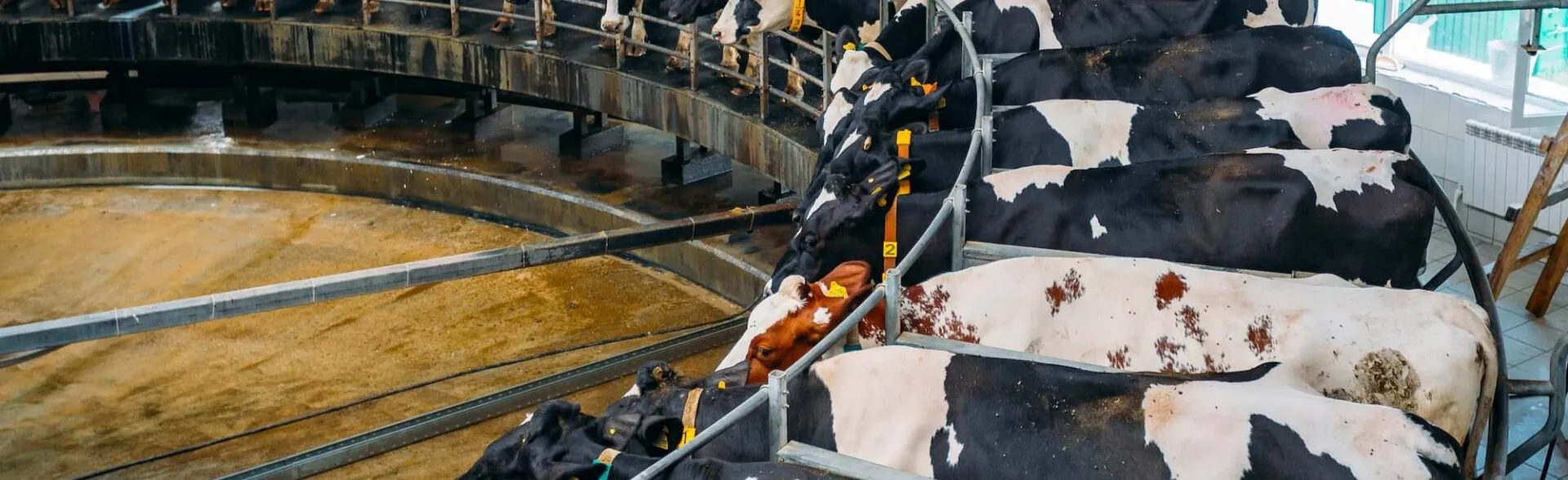
The dairy labor crisis is not a future problem. It is happening now, on farms across North America, every milking shift.
Finding qualified milkers is harder than ever. Retaining them is harder still. Agricultural wages continue to rise, and the pool of workers willing to perform physically demanding, shift-based parlor work is shrinking every year. Dairy producers need solutions that work regardless of what the labor market does next.
Key Takeaways
- Dairy labor shortages are accelerating, with agricultural wages rising and qualified workers harder to find
- Green Source Automation robots eliminate up to three labor positions per rotary parlor without reducing output
- One customer reduced parlor staffing from five to three workers and saved $270,000 annually
- Automation provides labor stability that human hiring cannot match
- Robots perform consistently across every shift, removing dependence on individual worker skill and attendance
The Scale of the Dairy Labor Problem
The numbers tell a stark story. Wisconsin dairy operations have watched the number of active herds shrink dramatically as farms struggle to remain viable. Labor availability is one of the most frequently cited reasons.
Agricultural wages have climbed to over $18 per hour on average, with skilled milkers commanding more in competitive markets. Beyond the wage, recruiting, training, managing, and replacing parlor workers consumes significant management time and operational resources.
Turnover in dairy parlor positions runs high. The work is physically demanding. Shifts run at irregular hours. Quality workers leave for other industries when alternatives are available. Each departure disrupts milking routines, introduces new variability into the parlor, and triggers another cycle of recruiting and training.
What Automation Actually Replaces
Dairy automation does not replace skilled herd management. It replaces the most repetitive, physically demanding positions in the parlor, the positions where consistent human performance is hardest to maintain.
The pre-dip position requires a worker to apply sanitizer and stimulate teats on every cow at every milking. On a large rotary dairy, this means performing the same motion thousands of times per shift. Fatigue, distraction, and physical strain make perfect consistency impossible over time.
The post-dip position carries the same challenge. Post-dip application requires precise coverage to protect the teat canal after the cluster detaches. Manual spraying inevitably varies in coverage, timing, and volume.
The wipe position adds a third demanding task. Workers must wipe residual pre-dip from teats consistently before cluster attachment, while keeping pace with the rotating platform.
Green Source Automation’s RotaryMATE product line automates these three positions. The EXPD handles post-dip. The EXPS handles pre-dip and stimulation. The EXPSPLUS combines pre-dip, stimulation, and wiping into a single robot, replacing up to three workers per shift.
The Stability Advantage
Beyond cost savings, automation provides something that no hiring strategy can guarantee: operational stability.
The robot shows up every shift. It performs the same way on day one and day 1,000. It does not call in sick, give notice, or leave for a higher-paying position down the road. It does not have a bad day that translates into inconsistent teat prep for 500 cows.
This stability has a value that extends beyond the labor cost calculation. Consistent parlor performance protects milk quality, supports herd health, and gives producers confidence that their operation runs properly whether or not the manager is present.
One Green Source customer described it simply: “I know the robots are going to be here. Green Source takes really good care of me.”
Scaling Without Adding Headcount
One of the most significant capabilities that dairy automation enables is growth without proportional labor increases. Expanding a traditional dairy parlor operation typically requires adding workers in proportion to cow numbers. Automation breaks that relationship.
A Green Source customer operating a large rotary dairy scaled from milking 3,000 cows to 6,000 cows. They did not add employees. The rotary parlor combined with Green Source robots made that scaling possible by handling more throughput without more labor.
This changes the economics of growth fundamentally. Producers can evaluate expansion based on facility, herd genetics, and milk market capacity, not on whether they can staff a larger parlor.
Addressing the Concern About Existing Workers
Dairy producers who care about their teams often express concern about automation displacing loyal employees. This is a legitimate consideration, and the practical outcome in most cases is reassignment rather than elimination.
When robots take over the pre-dip, wipe, and post-dip positions, experienced workers shift to roles that require more skilled judgment. Herd observation improves. Fresh cow management, reproductive monitoring, and individual animal care receive more attention.
Workers in automated parlors typically report higher job satisfaction. The physical monotony of repetitive dipping and spraying tasks disappears. Remaining work requires more skill and engagement. The operational benefit of having experienced people focused on herd health rather than teat spraying is real and measurable.
The Integrated Assurance Program
Green Source Automation recognizes that automation is a long-term commitment. The Integrated Assurance Program provides ongoing partnership throughout the life of the system.
Maintenance costs are fully transparent. Producers know what their automation investment costs over time without surprises. The program includes service support, parts management, and performance monitoring designed to keep RotaryMATE robots operating reliably around the clock.
For an industry where uptime is non-negotiable, this level of support matters. A parlor that cannot milk is a parlor that loses money every hour it sits idle.
Taking the First Step
Green Source Automation works with producers at every stage of the process. Whether you are planning a new rotary barn, evaluating your first automation upgrade, or expanding an existing automated operation, the GSA team provides engineering support and customer references at comparable operations.
Virtual tours and on-site visits to working Green Source dairies are available for producers who want to see the technology in action before committing.
Contact Green Source Automation at greensourceautomation.com or call (866) 600-8230 to start the conversation.
Frequently Asked Questions
How many labor positions does a single RotaryMATE robot replace? The EXPD replaces one post-dip position per shift. The EXPS replaces one pre-dip position per shift. The EXPSPLUS replaces up to two positions (pre-dip and wipe) per shift. With multiple daily milkings, total annual labor savings multiply accordingly.
What happens if the robot needs maintenance during a milking shift? The Integrated Assurance Program provides ongoing service support and parts availability. GSA designs its systems for industrial-grade reliability to minimize downtime. Maintenance schedules are proactive rather than reactive.
Can a dairy automate just one position to start? Yes. Many Green Source customers begin with the post-dip position and add pre-dip automation after seeing results. The EXPD is a strong entry point that delivers immediate labor and chemical savings.
How does automation affect worker safety in the parlor? Removing workers from the most physically repetitive positions reduces injury risk from repetitive strain. Workers remaining in the parlor operate in a less physically demanding environment overall.
